
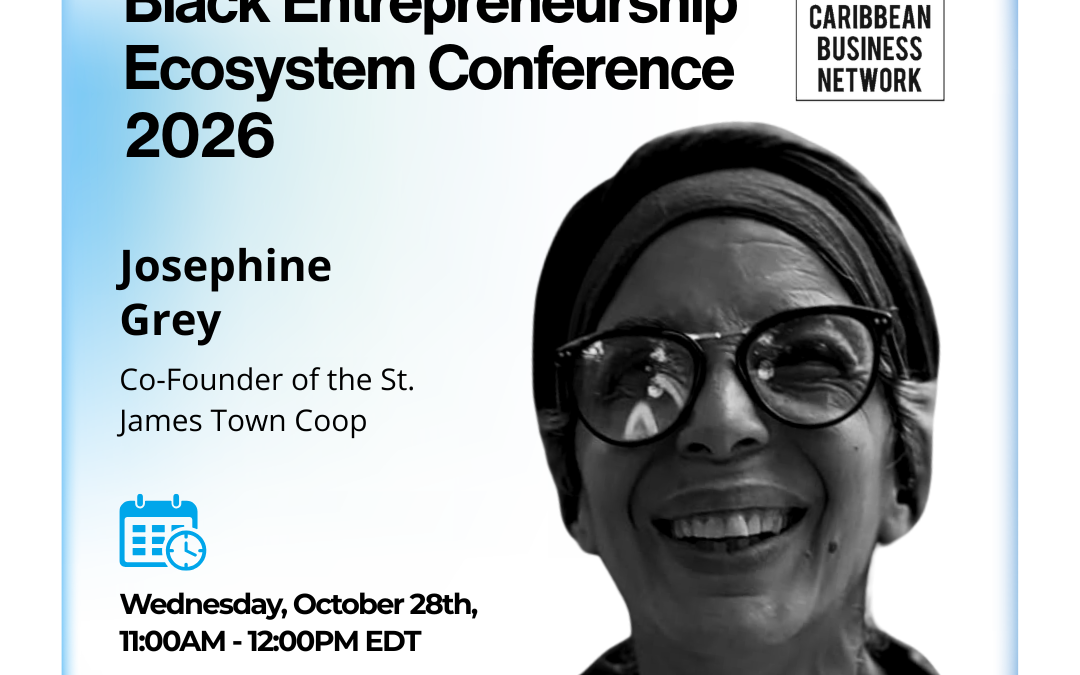
Afro-Caribbean Business Network | Fireside Chat with Josephine Grey, Co-Founder of the St. James Town Community Co-operative | Wednesday, October 28, 2026 | Online
Most businesses are built so that a few people own them. Co-operatives flip that idea. Instead, the people who use the business, or the community it serves, own and govern it together.
That is why the community co-operative business model deserves more attention in Black communities. After all, it offers a way to build shared wealth, keep decisions local and solve problems that neither government nor big business has fixed.
So on Wednesday, October 28, the Afro-Caribbean Business Network continues the Black Entrepreneurship Ecosystem Conference 2026 with a virtual fireside chat featuring Josephine Grey, Co-Founder and President of the St. James Town Community Co-operative in Toronto.
Who Is Josephine Grey?
Josephine has more than three decades of experience as a human rights advocate and community organizer. Over that time, she has founded or co-founded several influential organizations, including Low Income Families Together (LIFT), the Centre for Social Justice and the Income Security Advocacy Centre.
Today, she leads the St. James Town Community Co-operative and its OASIS Food Hub project. Above all, her work centres on a simple idea: communities have the knowledge and power to solve their own problems when they are given the tools.
One of the best ways to solve the ecological crises and climate crises we’re facing is to fix our food system. (Josephine Grey)
Inside the St. James Town Community Co-operative
St. James Town is one of the most densely populated neighbourhoods in Canada, with roughly 17,000 to 20,000 residents living in high-rise towers in downtown Toronto. Many are newcomers, and the area has been identified as one of the city’s economically disadvantaged neighbourhoods.
In 2019, the co-op launched the OASIS Food Hub to tackle food insecurity and build climate resilience. The idea was partly inspired by the 2003 blackout, when residents were suddenly cut off from food. Since then, the hub has grown to include:
- The Good Food Buying Club, offering healthy, affordable food from local farmers
- Micro-farms, including small aquaponics systems grown inside the neighbourhood
- Emergency food programs and a community garden
- Resident capacity building and the Roots Rising initiative
As a result, the hub had helped about 600 households by early 2024, supported in part by a $1 million, three-year investment from the Northpine Foundation.
Why This Conversation Matters for the Black Community
1. Shared ownership builds shared wealth
Co-operatives let people pool their resources and share in the rewards. Consequently, they can help communities that have been shut out of traditional ownership build assets together. That idea has deep roots in Caribbean and African traditions, such as rotating savings groups known as susu or partner.
2. Food is an economic opportunity
Food insecurity is also a business gap. Every community needs affordable, healthy food, and community-owned food enterprises can meet that need while creating local jobs. In short, solving a community problem can be a sustainable business.
3. Social enterprise can become self-sustaining
Josephine has said the co-op aims to become self-reliant and self-sustaining rather than depending only on grants. Similarly, many Black-led nonprofits are exploring earned revenue to reduce their reliance on funders.
4. Community capital keeps wealth local
At ACBN, we name the Four Strikes™ that hold Black entrepreneurs back, including systemic barriers to capital. Co-ops and community bonds are two ways communities can raise their own capital. In fact, ACBN is using a community bond to build affordable housing, keeping the asset and its returns in the community. Learn more about the ACBN community bond.
5. Clarity, connection, then capital
Whether you are starting a co-op, a social enterprise or a traditional business, the path is similar. ACBN’s 3C Framework™ moves entrepreneurs through Clarity → Connection → Capital. First, get clear on the problem you solve and your model. Next, connect with the community and partners who share your vision. Finally, access the capital to make it real.
Ready to build something for your community? ACBN’s Growth Pathway program walks you through the 3C Framework™ with coaching, community and a direct route to funding. We are welcoming 100 entrepreneurs into the program.
What You Will Walk Away With
- How community co-operatives work and who owns them
- How food hubs build resilience and local economic opportunity
- Lessons from three decades of community organizing and advocacy
- How social enterprises can move toward self-sufficiency
- A live Q&A with a co-op founder and human rights advocate
Frequently Asked Questions
What is a community co-operative?
A community co-operative is an organization owned and democratically controlled by its members, usually people who live in or use the services of a particular community. Typically, members share decision-making and any benefits the co-op creates.
Can a co-op be a business?
Yes. Many co-ops operate as businesses, from grocery stores and credit unions to housing and food hubs. In fact, credit unions like Alterna Savings are co-operatives owned by their members.
I missed the live session. Can I watch the replay?
Yes. Replays of BEEConference sessions will be shared on the ACBN YouTube channel.
Join Us on Day 28
Day 28 continues a full month of workshops through October as part of the Black Entrepreneurship Ecosystem Conference 2026. So if you believe communities can build their own solutions, this conversation is for you.
Fireside Chat with Josephine Grey | BEEConference Day 28
Wednesday, October 28, 2026 | Online
Can’t make it live? Subscribe to our YouTube channel so you never miss a replay, workshop or conversation: youtube.com/@acbn_canada
Connect. Build. Grow.