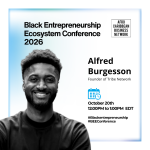
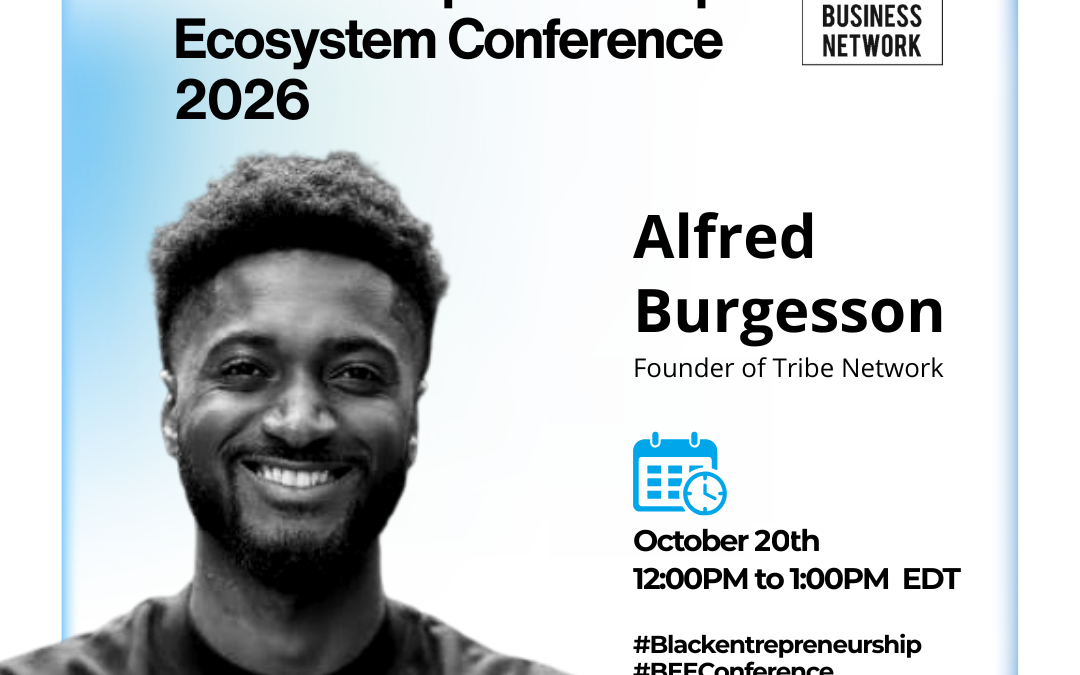
Afro-Caribbean Business Network | Fireside Chat with Alfred Burgesson, Founder of Tribe Network | Tuesday, October 20, 2026 | Online https://www.eventbrite.ca/e/fireside-chat-with-alfred-burgesson-beeconference-day-20-tickets-1999800638543
Most entrepreneurship advice assumes you already have something: a network, a mentor who returns your calls, an investor who takes the meeting. For racialized founders, that assumption is often the whole problem.
So what happens when someone decides to build the missing piece instead of waiting for it? That is the story behind Tribe Network, and it is why this conversation about Black entrepreneurs in Atlantic Canada matters well beyond Halifax. An ecosystem is not a building or a grant. It is people, relationships and capital arranged so that talent finally has somewhere to go.
So on Tuesday, October 20, the Afro-Caribbean Business Network continues the Black Entrepreneurship Ecosystem Conference 2026 with a virtual fireside chat featuring Alfred Burgesson, Founder of Tribe Network, on community, mentorship, access to capital and opportunity for racialized entrepreneurs.
Who Is Alfred Burgesson?
Alfred was born in Ghana and came to Canada with his family at age six, growing up in Nova Scotia. He attended Halifax Grammar School and Saint Mary’s University, and he began shaping policy long before most people start their careers.
In 2019, for example, he was appointed to the Prime Minister’s Youth Council for a two-year term, and he went on to co-chair Canada’s first State of the Youth Report. In 2021, he also led a research project for Senator Colin Deacon on the barriers Black entrepreneurs face in this country. In other words, he did the research, then built the answer.
His work has been widely recognized. He received the Public Policy Forum’s 2025 Emerging Leader Award, was named a 30 Under 30 Innovator by Atlantic Business and was named a Changemaker by The Globe and Mail’s Report on Business in 2023. In addition, he serves on the Board of Directors of the Black Opportunity Fund and on the Board of Governors of Halifax Grammar School.
I wanted to make friends, and I wanted to find my tribe. (Alfred Burgesson, on why he started Tribe Network)
Inside Tribe Network
Alfred founded Tribe Network to create what he could not find: a place where Black, Indigenous and racialized people could pursue entrepreneurship and professional growth together. Today the community has grown to more than 2,000 members, most of them in Atlantic Canada.
In practice, that support takes several forms:
- A free community workspace in a Halifax heritage building, open to members who need a desk, a meeting or a conversation
- Coaching and mentoring, including virtual sessions, so founders outside the city are not left out
- Grants of $500 to $5,000, small amounts that remove very real obstacles at the earliest stage
- Tribe Ventures, an early-stage fund backing technology companies led by underrepresented founders
Moreover, the results show up in the wider economy. Tribe members have created hundreds of jobs and raised millions in capital, and in January 2026 Alfred took a leave of absence from the organization to serve as a Senior Advisor in the federal Office of the Minister of Artificial Intelligence and Digital Innovation, bringing a community builder’s perspective into national technology policy.
Why This Conversation Matters for the Black Community
1. Ecosystems are built, not inherited
Nobody handed Atlantic Canada a Black business ecosystem. Instead, it was built member by member, introduction by introduction. Consequently, Alfred’s story is a practical blueprint for any community that feels too small, too scattered or too far from the centre of things.
2. Belonging comes before business
Notably, Tribe began with a desire for connection rather than a business plan. That order matters. When founders feel they belong somewhere, they ask for help sooner, share opportunities more freely and last longer in business.
3. Small capital, early, changes outcomes
A $500 grant will not scale a company. However, it can cover an incorporation fee, a first product run or the software a founder has been doing without. At ACBN, we see the same pattern with our microloans of $1,000 to $10,000: the first yes is often what makes the next one possible. (Our Day 19 spotlight explains how small business microloans in Canada work.)
4. Networks are one of the Four Strikes
At ACBN, we name the Four Strikes™ that hold Black entrepreneurs back: small teams, difficulty attracting talent, overconcentration in professional services and systemic barriers to capital, credit and networks. Alfred’s entire body of work goes at that last barrier, which is exactly why organizations like Tribe and ACBN exist.
5. A seat at the policy table
Finally, his move into federal AI and digital innovation policy is a reminder that representation matters in the rooms where rules get written. When the people shaping technology policy have spent years with underrepresented founders, the resulting programs are far more likely to reach them.
6. Community first, then capital
That sequence is ACBN’s 3C Framework™ in action: Clarity → Connection → Capital. First, get clear on what your business needs and what the numbers say. Next, connect with a community that opens doors. Finally, access capital with the readiness and relationships to use it well.
Ready to find your people and your funding? ACBN’s Growth Pathway program walks you through the 3C Framework™ with coaching, community and a direct route to funding. We are welcoming 100 entrepreneurs into the program.
What You Will Walk Away With
- How to build an entrepreneurial community from nothing, wherever you live
- Why mentorship and belonging drive business results, not just morale
- How small grants and early capital unlock bigger funding later
- What racialized founders in Atlantic Canada can teach the rest of the country
- A live Q&A with one of Canada’s most recognized young ecosystem builders
Frequently Asked Questions
Where can Black entrepreneurs in Atlantic Canada find support?
Tribe Network, based in Halifax, supports Black, Indigenous and racialized entrepreneurs with a community workspace, coaching, mentorship and small grants, and much of its programming is virtual. In addition, national organizations such as ACBN offer loan readiness coaching and microloans, and national events like the BEEConference connect founders across provinces.
What is Tribe Network?
Tribe Network is a Halifax-based nonprofit founded by Alfred Burgesson that supports Black, Indigenous and People of Colour entrepreneurs in innovation-driven sectors. It has more than 2,000 members and runs programs, workspace and an early-stage fund, Tribe Ventures.
I missed the live session. Can I watch the replay?
Yes. Replays of BEEConference sessions will be shared on the ACBN YouTube channel.
Join Us on Day 20
Day 20 continues a full month of workshops through October as part of the Black Entrepreneurship Ecosystem Conference 2026. So if you have ever felt like you were building alone, or you want to build the room you wish existed, this conversation is for you.
Fireside Chat with Alfred Burgesson | BEEConference Day 20
Tuesday, October 20, 2026 | Online
Can’t make it live? Subscribe to our YouTube channel so you never miss a replay, workshop or conversation: youtube.com/@acbn_canada
Connect. Build. Grow.